7 Must-Know Cosmetics Brands for 2026
Looking for the cosmetics brand that will make a difference in 2026? Protocols, innovation, organic, luxury or sensory: 7 brands to test in your treatment room.

In 2026, taking care of yourself is no longer a luxury reserved for a few.
It has become necessary. Sometimes even essential.
The pace is accelerating, schedules are overflowing, and demands follow one after another without pause. Many people feel this very concretely: we move fast, we do our best… and end up putting ourselves last.
On the ground, in the treatment room as well as the salon, it is immediately apparent. Expectations have changed. People no longer come solely to “treat themselves” for an hour between two appointments. They are looking for something else. A refocusing. A reconnection. Something more balanced, sometimes simpler too.
Self-care has taken on a different role. Less spectacular, less showy. More essential.
And often more lasting.
This article is not intended to promise ideal transformations or perfect routines. It is designed for real life. That of skincare professionals, as well as their clients. Concrete, practical insights, adapted to current constraints. Body, mind, environment, rituals, wellness trends… everything is addressed with a clear idea: to bring back meaning, without pressure or guilt.
If you feel like changing your perspective on self-care, making it a real daily support rather than just another obligation, then you can move forward differently. At your own pace. Without forcing yourself.
When you work in a treatment room, you see a wide range of different profiles. Yet, one observation often recurs: self-care is no longer seen as a whim. In 2026, it is part of a search for overall balance, where the body, mind, and social connection matter equally, as the World Health Organization also reminds us.
Expectations have evolved. Many clients now talk about authenticity, a return to basics. Fewer demands, less performance at all costs. Mental well-being has finally entered the equation. Emotional fatigue, mental load, personal or professional transition periods… all of this is directly reflected in the skin, posture, and overall energy.
On the ground, we are seeing a real rise in customized routines. More holistic. More mindful eating, gentle movement, breathing, micro-breaks during the day. Nothing extraordinary taken separately. But together, they create a coherence that settles in.
The figures confirm this trend: nearly 70% of French people already stated they wanted to improve their overall well-being in 2025. In the salon, this translates into more refined, more thoughtful requests. The main obstacle often remains the same: time. And sometimes, the difficulty of allowing yourself to slow down.
Today, self-care is no longer a stolen moment. It encourages a more stable, adaptable, realistic lifestyle.
On the ground, we see it every day. When one of the three is out of balance, everything else follows.
There is no need to change everything. A simple diet, sufficiently varied, without excessive rigidity. Regular hydration – often underestimated – which nevertheless makes a big difference, especially for the skin and energy. Sleep, meanwhile, remains a foundation. You can cheat occasionally, but not sustainably.
When it comes to movement, gentle exercise has become established. Walking, stretching, breathing. Integrating the body throughout the day rather than forcing it into unrealistic time slots. Touch also plays a key role: self-massage, salon treatment, simple but regular gestures. The body gives signals. The challenge is learning to listen to them.
In the treatment room, it is quickly apparent. Dull skin, tense features, shallow breathing. The mind leaves its mark. A few minutes of conscious breathing, a power nap, a screen-free ritual before bed… often, that is enough to rebalance a day.
Keeping a journal, noting what soothes or what tires you. Turning off the phone a little earlier. Creating real breaks. Self-care sometimes starts there, in these quiet spaces.
The environment works silently, but its impact is real. Softer lighting. A plant. A slightly more uncluttered space. In the treatment room, we know how much a well-thought-out setting makes it easier to let go. At home, it is the same logic. Providing a quiet corner, even a minimal one, is sometimes enough to create a space for rest.
In 2026, the perfect routine does not exist. And that is rather good news.
What really works in the long term is consistency. Three minutes every day is worth much more than a grand ritual abandoned after a week.
In the morning, for example:
a glass of water, a quick facial self-massage, a few deep breaths. Nothing rigid. Just an anchor point.
In the evening, make room for recovery. Gently cleanse the skin, apply a suitable oil, dim the lights. Turn off screens as much as possible. Even imperfectly, the effect is there.
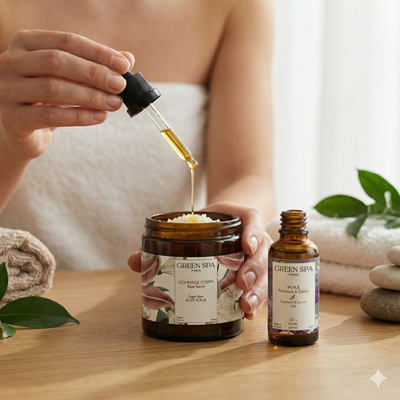
Natural treatments easily find their place. Gentle exfoliation, express mask, massage inspired by spa protocols. The choice of oils remains crucial: it is better to have a few, but well-chosen. Observe your skin, adjust according to the season, accept changing your pace.
Here, consistency always takes precedence over performance.
The benefits of self-care are concrete. In the salon, they are immediately apparent. Stress decreases, features relax, breathing opens up. At home too, when the gestures become familiar.
Studies go in the same direction: lower cortisol, improved sleep, better self-perception. Many clients talk about lasting well-being after a few weeks, provided they remain consistent.
The skin also responds. More suppleness, less tightness, a more stable glow. Provided you respect its real needs and choose well-formulated products, consistent with the skin.
But let's be honest: the journey is never linear. There are breaks, slumps, moments of letting go. That is normal. Self-care is not a straight line. It is a living practice, adjustable.
In the salon, customization has become established. No protocol is applied identically. The skin, emotional state, and season dictate the adjustments.
For the body, massages remain central. Relaxing, draining, invigorating. Touch makes the difference. The oil, the pressure, the pace. Everything is played out in the details. A tense back is not worked on like heavy legs. You have to feel, adapt, sometimes improvise.
Exfoliations and wraps retain all their relevance, provided you respect the frequency and energy of the moment. Some innovations find their place, but nothing replaces the practitioner's hand, listening, immediate feeling.
Alternating home care and salon appointments remains one of the most lasting balances. The professional brings an outside perspective, an adjustment. Daily life maintains.
On the ground, it is often the little things that last over time. Blocking out a slot, even a short one. Preparing your space in advance. Having one or two reliable products on hand. No more.
Sharing your routines also helps. Talking about it, exchanging ideas, taking an idea here or there. The collective supports consistency. Measuring your feelings more than your results. Simply asking yourself: how do I feel today?
Current trends clearly go in this direction: adaptable, realistic self-care, anchored in real life. Not spectacular. But deeply transformative.
Taking care of yourself, in 2026, is not doing more.
It is often doing better. Less intensely. More fairly.
If the time seems to have come to refine your rituals, to give yourself real time for yourself – in the salon or elsewhere – then the next step is simple. We can talk about it, adjust it, build something that truly resembles you.